Thread #25058666 | Image & Video Expansion | Click to Play

File: Dante.jpg (186.1 KB)

186.1 KB JPG
I'm Español Second Language and I'm trying to read Lorca and even though I have enough enough of a grasp of the vocabulary and grammar to follow him, I'm still getting confused as hell.
The poem in question is from Poeta en Nueva York
>Vuelta de paseo
>Asesinado por el cielo,
>entre las formas que van hacia la sierpe
>y las formas que buscan el cristal,
>dejaré crecer mis cabellos.
>Con el árbol de muñones que no canta
>y el niño con el blanco rostro de huevo.
>Con los animalitos de cabeza rota
>y el agua harapienta de los pies secos.
>Con todo lo que tiene
>cansancio sordomudo
>y mariposa ahogada en el tintero.
>Tropezando con mi rostro >distinto de cada día.
>¡Asesinado por el cielo!
Can any Spanish-speaker explain? I have tried reading it with a Castilian accent and it didn't help
16 RepliesView Thread
 Showing all 16 replies.
>>
>>25058666
I'm a native speaker and I'm getting filtered too. I think the first stanza is talking about laying on a tree, his use of the word sierpe leads me to believe that since I don't know what other definition would fit better here.
>>
>>
File: Screenshot 2026-01-31 191056.png (60.1 KB)
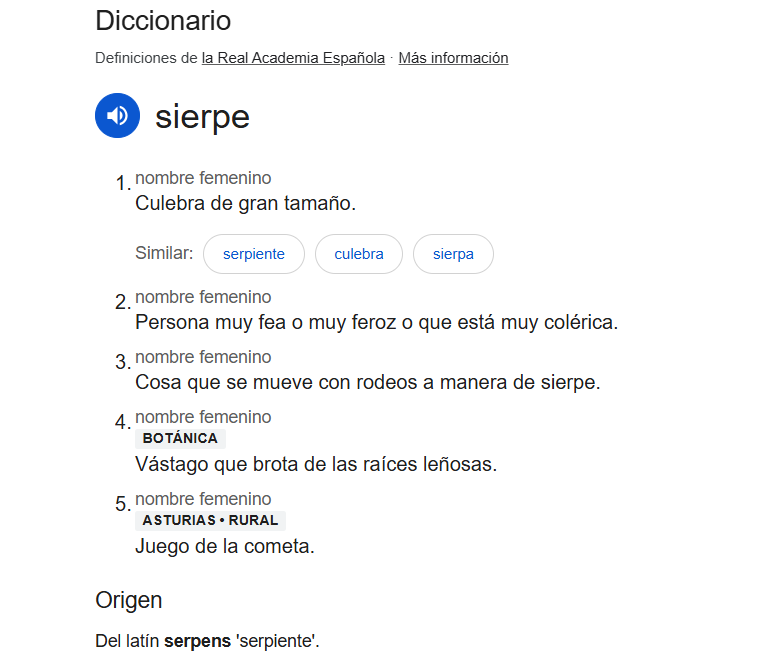
60.1 KB PNG
>>25058718
I understand sierpe here to mean tree branch, so when he says he is among the forms reaching for the sierpe (branch) and the forms searching for the crystal, which I'm interpreting as the sky/heavens, he is saying he's upon a tree, resting against it or something along those lines. That's what makes the most sense to me, but I'm not sure about the rest of the poem. It could be a felled tree since he says "muñones que no canta", which could imply a tree with broken branches, like mutilated limbs.
>>
>>25058814
Well this is my reading, I don't know if it makes sense but it's mostly informed by the fact the poems are about being in New York City
Opening line is at first deliberately cryptic. In the next line, sierpe, I take to mean the subway but maybe it also means the streets or perhaps the sidewalk itself. Cristal in the next line I take to mean the skyscrapers. The poet is walking between people on the sidewalk, and we know that from the title of the poem, he's reflecting after returning from a walk. The tree in the next stanza seem to be completely denuded of all its beauty, hence "no canta". The "blanco rostro de huevo" suggests to me a totally blank face. One the surface it says his fave is white as an egg's, but it also suggests blank like an egg's.The "animalitos" in the next line are probably roadkill. The agua in the next is, I think, puddles. The next line is about people marching, oblivious and tired. And the next line we have this strange imagery of tintero. That can have any number of interpretation so I don't dare hazard a guess here. The next line "tropenzando" I guess to mean tripping over puddles potholes which reflect "mi rostro". Then the line closes with its opening line, reminding of it, and which it apparently serves as an explanation for. But I am still struggling to understand how it explained it. The first thing that occurs to me is a bird swooping down on prey but there is no indication of that, I'm still groping about for other images the line could refer to
Does this sound plausible, or totally off the mark?
>>
>>25058872
I think it does sound plausible. In the context of the city, your interpretation seems more appropriate than what I originally suggested. I guess I was interpreting sierpe too literally. I don't understand the alleged explanation at the end either, sorry.
>>
>>25058961
The poem seems to be itself the explanation for what he means by the first line, and I think that because he repeats the first line at the end. It feels like the first line is out of context and stream-of--consciousness, and then he does a flashback in his mind of the reflections that brought him to that thought and concludes by repeating the thought with more emphasis. Another possible explanation maybe be that the day destroys him, each day kills his old self with what he is experiencing and taking in America and how it reconfiguring everything he took for granted. However this would seem more upbeat than the general tone of the poem which is consistently restrained sorrow. Is the mariposa meant to be him (Lorca must have been aware of the slang usage)? Since this collection of poetry was banned in Spain despite being a best seller in Mexico, and he was killed himself by Francoists due to his poetry? Is he being murdered by his ink and the the sky, figurative for his inspiration? Because his inspiration compels him to write and the ink allows him to? Is reflecting on the death, physical and spiritual around him, and realizing now he will be joining the fraternity of the dead? Is the message of the poem ultimately fatalist, like he is walking through or toward the underworld?
>>
>>
>>
>>25058666
I don't think Poeta in Nueva York is supposed to be explained rationally. Is deliberately obscure. I can imagine Lorca walking around New York, looking up to the sky between the skyscrapers and maybe that's what the image is all about. I dunno.
>>
According to his letters, "Asesinado por el cielo" refers to how he felt completely dwarfed and obliterated by the vastness of New York City and the enormous skyline. He said all of Grenada, his hometown, could be contained by three skyscrapers.
>>25061230
>comprendí que me habían asesinado.
>Recorrieron los cafés y los cementerios y las iglesias,
>abrieron los toneles y los armarios,
>destrozaron tres esqueletos para arrancar sus dientes de oro.
>Ya no me encontraron.
>¿No me encontraron?
>No. No me encontraron.
Pretty prophetic desu
>>
It's him reminiscing about his native Spain while being, like previous poster mentions, awestruck by the crystal towers of New York. In the first and last stanza he communicates his existence bridging both worlds in him being a Poet. His meager status as a Poet is also compared to the meagerness of His Homeland in contrast to The New York skyscrapers. The more appropriate title would be 'A Spanish poet in New York'
>>
>>25063134
Do you think most of America during the great depression was like New York City though? Lorca was on Wall Street the day of the crash and witnessed six suicides which he talks about in a letter. He said Wall Street struck him as a place where gold flowed in from all over the world, and blood flowed out, and that he believing the absence of spirit was more acute there than anywhere else on the planet. Most of America was more like rural Spain that New York City
Lorca did entertain a couple of other titles to the work, including An Introduction to Death
>>
>>
>>25063177
No, I'm saying the contrast is not New York contra Spain as you suggest by "Spanish Poet", it's New York contra nature. He isn't depicting a clash between his Spanish culture and American culture, he actually liked a lot of American culture
>>
File: 1000240058.jpg (391.3 KB)

391.3 KB JPG
>>25058666
I guess I'm late to the party, but I think this app may help you with your español. Btw bonitos triples.
>inb4
Shoo shoo phone poster yata yata yata.