Thread #97485934 | Image & Video Expansion | Click to Play

Discussion for West Marches / hexcrawl (DND 5e) Anonymous 02/02/26(Mon)13:09:37 No.97485934 [Reply]▶
File: hexcrawl.jpg (482.9 KB)

482.9 KB JPG
Greetings fellow adventurers,
I recently started a West Marches-style campaign (with a strong hexcrawl exploration element) at my LGS. I created a similar thread before it started, so I'm creating a second version of it. What I have so far:
>2 sessions in (different groups, 9 players total)
>another 2 sessions scheduled for this week (4 returning players, 7 new)
>likely another 1 next week (4 returning players, 2~3 new)
>leaning towards creating a Discord to organize discussion for the campaign
For the first sessions I spent a lot of time creating terrain description & table of random encounters/etc:
>everything is generated on the fly (including terrain)
>i have ~9 different biomes w/ different descriptions
>2 monster tables for each biome
>a random table for terrain/environment challenges
>a random table for treasure troves/etc
>a random table for landmarks/features
>a random table for finding small things
For this week, I will be doing more player-oriented prep, but I'm also looking for:
>additional interesting mobs (players start at level 3)
>additional treasure/rewards that is NOT gold or equipment
On the subject of rewards, things I have:
>shrines that grant permanent attribute boost
>shrines that grant session-long buffs
>ways to learn new spells
>lore/maps
In addition, any West Marches or/and hexcrawl discussion is welcomed
Come in, let's explore this thing together!
>previous thread:
https://archive.4plebs.org/tg/thread/97308471/
40 RepliesView Thread
 Showing all 40 replies.
>>
>>
>>
File: planning.png (3.6 MB)
3.6 MB PNG
>>97486376
>How did you advertise your campaign, did you just gang up flyers at your LGS or something?
There's a chat group dedicated for playing TTRPG on the LGS, so I simply advertised there. I also invited some friends that I thought could be interested
This particular LGS is starting to focus on TTRPG, have a dedicated room/basement for it that can support 2 tables at a time. I already booked a permanent table every other Tuesday night, though this week I got an additional slot to also DM on Wednesday night
On top of that, my regular group that meets every Thursday is also joining the same campaign, they played once but should also be playing every other week (I'm enforcing a rule that they can't play two weeks in a roll, to avoid their party moving too quick). This group has about 4~6 "fixed" players, and occasional guests. I might also run additional tables for friends every now and then. This part sounds silly but I think this will fuel even more the engine of the West Marches style of game, since both groups (the LGS players and my friends) will be interested in finding out what the other did and maybe race the other group for content
>>97486332
>pace of those games
What pace would you recommend then, my good sir?
Its unfeasible for me to commit to too many games at once, so every other week is the most I can commit to a permanent slot at the LGS
>Makes another about the same subject
I already had 2 sessions in, and +2 sessions coming in this week (hopefully both during this thread's lifespan). That's a substantial amount of sessions given that A LOT of game groups die within 1-3 sessions. Within this thread I will also have achieved a 14~16 player base which is definitely WM-worthy
So yeah, I definitely have more things going on now than 2 weeks ago
>>
File: loot table.png (64.4 KB)
64.4 KB PNG
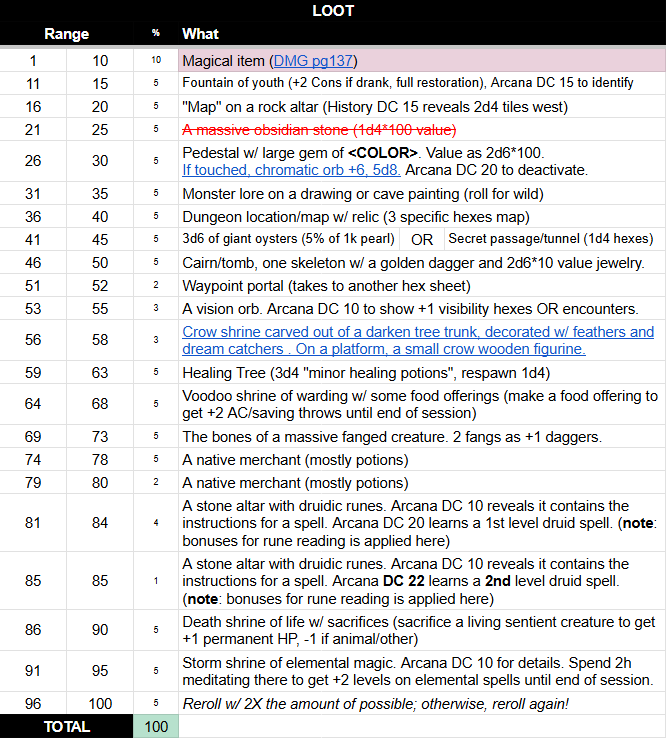
Sharing my treasure/rewards table to contribute to the thread. Even though I'm calling it "loot" on the pic, its not really loot from monsters/encounters, but rather something that has a chance of being encountered in the wild (which might be potentially surrounded by mobs)
Any additional ideas for rewards that are not magical items and/or valuables (gold/etc) are welcome!
PS: as most of my tables, this is a dynamic table and I change it depending on what is found (once an entry is found, I might reduce its % or replace it with something else)
>>
>>97485934
I recently ran a Dolmenwood open table / "west marches" game that lasted a few months. I used 1:1 time and learned some interesting lessons. It was the second west marches style game i've ran, the first was an AD&D 2e game a couple years ago.
I learned that 1:1 time is good but also kind of pointless if you're not making players closely track things like living expenses. i also think i ran it a little too "literally" and it made travel times kind of annoying.
these kinds of games really live or die based entirely on player engagement, that's what ended up kind of killing both my games after a couple months, people just lost interest and stopped scheduling sessions.
i think 1:1 time is actually really important for this style of game because it keeps things consistent, though i recently watched a video that explained it better and i think in the future i'll probably run it the way the guy in the video runs it - rather than spacing sessions out based on travel time, i'd run the session as soon as we're able and just have the characters be "time locked" for however long travel and exploration / dungeon diving would take.
i think this style of game really requires players to make multiple characters as well, which a lot of players seem to struggle with in my experience, it seems everyone is so used to traditional play with one character.
the video, for anyone interested: https://www.youtube.com/watch?v=h-wclYkx8Ic
>>
>>
>>
File: 453nMlK.jpg (153 KB)

153 KB JPG
>>97487815
>the video, for anyone interested: https://www.youtube.com/watch?v=h-wclYkx8Ic
Might check out, I love going through youtube guides, I find they very insightful (even when the video itself isn't)
>I used 1:1 time and learned some interesting lessons
I'm kinda considering it, in a way. Since its a West Marches style (and not just a hexcrawl), I need to take session time in consideration. With that in mind, travel is pretty much streamlined during play, and doesn't happen off session
Right now, I'm just adding the days of each group after each other:
>group A played for 3 in-game days (days 1 - 3)
>then if group B plays for 4 in-game days, those will be days 4 and 5
Though that avoids complications, its kinda sad that different PC can't be doing things at the same time
Still, while making some of my notes, I have a lot of events tied to real-world time. Eg:
>"february: 2d6 kobolds are here"
>"after feb: 50% chance the kobolds have left"
The reason why I tied it to RL calendar is because its easier than checking that session is the current one
If that makes sense?
>these kinds of games really live or die based entirely on player engagement
>people just lost interest and stopped scheduling sessions
Yeah, I bet. Which is why I'm taking some measures:
>having 2+ groups playing in parallel means the world is always changing, even for players that never miss a session
>I'm booking additional tables at the beginning to increase player pool, so that there's more people competing for seats at the table in the future
>I'm putting together a Discord for this as well, and I want to have ways to engage players that are not being able to play anymore (due to RL reasons)
>>
File: spring.png (2.4 MB)

2.4 MB PNG
>>97487830
>5e doesn't even include rules for hex crawling or dungeon crawling, how the fuck do you think this is going to go?
Sounds like the kind of thing you would have known if you checked the previous thread. But in a nutshell:
>be me
>be unemployed
>be a game designer
So naturally, I designed a simple hexcrawl travel system:
>in-game travel day is made up of 4 slots of 2h each
>each hex takes time to travel based on type of biome
>2h -> plains, deserts and beaches
>4h -> forests
>6h -> jungles, swamps and hills
>8h -> mountains
>hexes also have a visibility score based on the type of biome
>normal biomes show what is around them (visibility 1)
>forests, jungles and swamps don't (visibility 0)
>hills and mountains reveal hexes far away (visibility 2 and 3, respectively)
Basically we have been using those simple rules, and I make it clear to my players how they work so they can make their own decisions based on those
>>97488046
Though I'm highly interested in non-D&D systems, I can't change systems half-way, and its good for a *public* West Marches style game to use a well known system that players can be familiar with before joining the table (even if that system sucks orc dicks)
>>
>>97485934
Nice, I'm glad it's working out for you.
>>97488046
Acksfags are becoming worse than Gurpsfags
>>
>>97488742
the fact that you're playing in person is already an advantage when it comes to retaining player interest, i was playing exclusively over discord and i think that probably contributed to player disinterest.
>>
>>97485934
>shrines that grant permanent attribute boost
except that "shrines" is heavily part of your setting diversify it a bit so its less gamey (Diablo shrines).
Make it a random table of how they obtain the boon.
> You cross path with a fae and if you don't annoy me he grants you some fae related power like speaking with animals 15 limited uses
Or something like that
>>
>>97489387
>glad it's working out for you
First 2 sessions were great, hoping to continue the trend this week
>>97489987
>playing in person is already an advantage
Yeah, I get you. I tried online TTRPG a couple of times but even as DM I lost interest pretty quickly. To me, it loses a lot of its appeal
By inviting a large number of players, I'm hoping that at least half will keep interest and play somewhat regularly. Though I'm definitely investing in giving players reasons to engage with the game/story:
>i'm letting players name places they discover
>satisfaction from discovering the word/new places
>good XP reward for playing / character progression
And most importantly:
>FOMO
I want active players to talk about what they did, to make people that missed the session regret it lol
>>97490018
I really like shrines, and yes, I had Diablo shrines in mind. Nevertheless, have you checked the table here >>97487487 ? Typically each shrine has its gimmick, especially the recurrent ones. Also note that the result from this table is often associated with mobs, so it adds some dynamic to it (something like the fae example you mentioned). For instance, the VERY first tile players explored on the first session was a shrine of blood offerings (sacrifice 1d4 hp to gain combat advantage until end of session), but the party didn't go near it because it was surrounded by mobs
But nevertheless, I'm definitely open to more ideas
>>
File: river.jpg (437.1 KB)

437.1 KB JPG
So, hexcrawl question
Anyone has inputs/ideas on how to handle rivers?
So far I've been simply considering them to be a feature of the hex, though with some different crossing properties/skill check requirements. However, it just occurred to me that maybe it would make more sense for rivers to exist *between* hexes, creating a natural border/boundary and making crossing more relevant game-wise
Thoughts?
Pic related:
> left is my WM's campaign current map, with a river inside hexes
> right is just a sample of how rivers would be on edges/between hexes
>>
>>97491994
So as a piece of wisdom, one reason one might advise against that is because you don't just care about going across rivers but also going up and down them. I would argue, in fact, that the directionality is more determined by the up and down than by the "crossing point". This matters because typically you can use a river as a way to increase travel speed, but typically at the expense of constraining player movement to certain directions and maybe increasing overall distance (but always decreasing time). In that sense it's better to know which hex the river is coming out of and which hex it is flowing into.
>>
File: 3a7599699662d0827edaf587e7bb0f81.jpg (46.2 KB)
46.2 KB JPG
>>97492265
>don't just care about going across rivers but also going up and down them
>directionality is more determined by the up and down than by the "crossing point"
Yes naturally
Rivers are an important geographic feature, a lot of things spring out of them - not just borders, but travel directions/routes, settlement locations, etc
In terms of hexcrawl mechanic, I basically have travel rules & encounter tables based on biomes (plains, forest, jungle, etc). The only 2 exceptions are:
>coast
On hexes that border the ocean, if players decide to travel on the border (beach), I used coast rules/encounter tables. This is a good way to travel because it tends to avoid hard terrain and facilitates mapping out the continent's land mass
>rivers or lakes
On hexes that have river, if players decide to travel bordering the river, I also use the rules/encounter tables for fresh water situations. Likewise, if there's a lake hex adjacent and players decide to travel through the lake's margins, I also use the same rules/encounters
So in that in mind, whether the river is within the hex or on the edges, it doesn't change that much. What really changes is that it avoids hex confusion, such as last session where the party spent several days adventuring through the same hex on one margin of the river, but never crossed it - therefore, the hex is marked as "explored" while they have never been to the other margin
>In that sense it's better to know which hex the river is coming out of and which hex it is flowing into
Is doesn't really matter?
If the river is on the edge of hexes, it will flow to some direction regardless. If players decide to travel by river (on boats or the like), they have even more choice because they can keep going or disembark on either sides of the river (thus, having access to 3 different directions - left bank, right bank or downstream)
So I guess I don't get your argument... all you said is true... but its true for both cases lol
>>
>>97491994
If it takes time and resources to cross, its already relevant game wise.
If it comes up as terrain in encounters of that hex, its already relevant game wise.
If the factions use it for transport, economics, etc. its already relevant game wise.
Resist your urge to fiddlefuck with things. Keep it simple. The point of the hexes is to help you organize gameplay into something more plausible, not to add more game buttons.
>>
>>97485934
>>everything is generated on the fly (including terrain)
>>i have ~9 different biomes w/ different descriptions
>>2 monster tables for each biome
>>a random table for terrain/environment challenges
>>a random table for treasure troves/etc
>>a random table for landmarks/features
>>a random table for finding small things
plase share these. mine were lost when my computer fried
>>
>>
File: WhatsApp Image 2026-02-03 at 16.28.35.jpg (167.3 KB)

167.3 KB JPG
OP here
To make the setting feel more organic, I'm implementing some services based on PCs. Right now (pic related) we have a blacksmith who can grant a +1 to a piece of equipment (Blessing of the Forge) and a fortune-teller who can predict how a given hex will go (Augury spell)
>>97492833
>Resist your urge to fiddlefuck
Its not really fiddlefuck - I've been trying to keep those at bay (more importantly, with all the homebrew mechanics related to WM/hexcrawl, I've been enforcing a strict RAW for anything related to PCs)
>point of the hexes is to help you organize gameplay
That's the idea though of rivers between hexes. While it loses "realism"/aesthetics, it streamlines gameplay, since we can more consistent through each hex as its own (rather than have a hex being two split hexes, one half for each side of a river)
It wouldn't add a single mechanic/rule, but remove a substantial amount of complexity
>>97492861
My tables are very specific to setting, and are dual-language (I tend to make things in English but I'm DMing in another language... it gets messy)
Nevertheless, I did share a good sample here >>97487487 . Might share later the other tables of that kind since these seem to be mostly in english
>>97494176
>Fixed movement rates or dice?
I'm doing *mostly* fixed, though there are some variations - specific places might have terrain modifiers (on top of their regular biomes)
One big argument against dice IMO is that it takes away player capacity to plan their journey. With a fixed movement cost per biome, my players often choose their path based on how many hours it will take, whether they can make it before nightfall, etc. Sure, sometimes things go off the rails and don't work out, but at least they have a good grasp of what they are doing and how much that will cost the (in time)
>roll for weather every day
I haven't implemented weather yet but I'm strongly considering pre-reroll for weather in advance
>>
>>97494339
>>>97492861 (You)
>My tables are very specific to setting, and are dual-language (I tend to make things in English but I'm DMing in another language... it gets messy)
>Nevertheless, I did share a good sample here >>97487487 . Might share later the other tables of that kind since these seem to be mostly in english
please share
>>>97494176 (You)
>>Fixed movement rates or dice?
>I'm doing *mostly* fixed, though there are some variations - specific places might have terrain modifiers (on top of their regular biomes)
>One big argument against dice IMO is that it takes away player capacity to plan their journey. With a fixed movement cost per biome, my players often choose their path based on how many hours it will take, whether they can make it before nightfall, etc. Sure, sometimes things go off the rails and don't work out, but at least they have a good grasp of what they are doing and how much that will cost the (in time)
how about this: you roll dice for movement in unexplored hexes. once you have explored them you can move freely
>>roll for weather every day
>I haven't implemented weather yet but I'm strongly considering pre-reroll for weather in advance
My main problem with weather is that unless they get into a fight and have a long stretch of no combat they can easily travel for a week in a minute of play. each hex is 6km in my game.
>>
File: session 3.jpg (126.8 KB)

126.8 KB JPG
Soooo
Ran the 3rd session today... this was potentially the best session I *ever* DM'ed (I've been doing it ~20 years)
Nevertheless, I will focus on highlights regarding the campaign, WM or/and hexcrawl highlights:
>3 players from first session (aka "the gnomes")
>1 player from second session (aka "the barbarian")
>1 new player
>gnomes immediately started interacting w/ the barbarian and organically asking more about what happened on his session
>great WM dialog coming up organically, such as:
B: "on this river we found a warrior from a native tribe, we should find more about them. He fled upstream"
G: "maybe we can travel upstream by boat... actually, Mr. Barbarian, you have been there... how is the current there?"
B: "oh, very fast, it will be hard to go upstream"
G: "alright, so instead we might go by land and use the trail you guys trailblazed last session"
>players thus decided to investigate more about the natives
>players decide to use the services provided by PCs not in the session (see >>97494339)
>the augury revealed that the next hex upstream was "good vibes"
>they found 2 native women
>no combat, just a long & interactive encounter w/ them (they didn't speak their language)
>some tensions, lots of laughter, lot of knowledge learned
>native women told party about the new hexes (pic related, right is post-session)
>native women also told that jungle belongs to an enemy faction
>they even managed to convince one of them to back to camp w/ them
>that woman will now be a npc players will be able to interact w/ off session
I seriously couldn't predict a more dynamic and smooth session, with such storyline progression and player engagement
VERY excited for tomorrow's session (1 recurrent player, 5 new ones)
>>
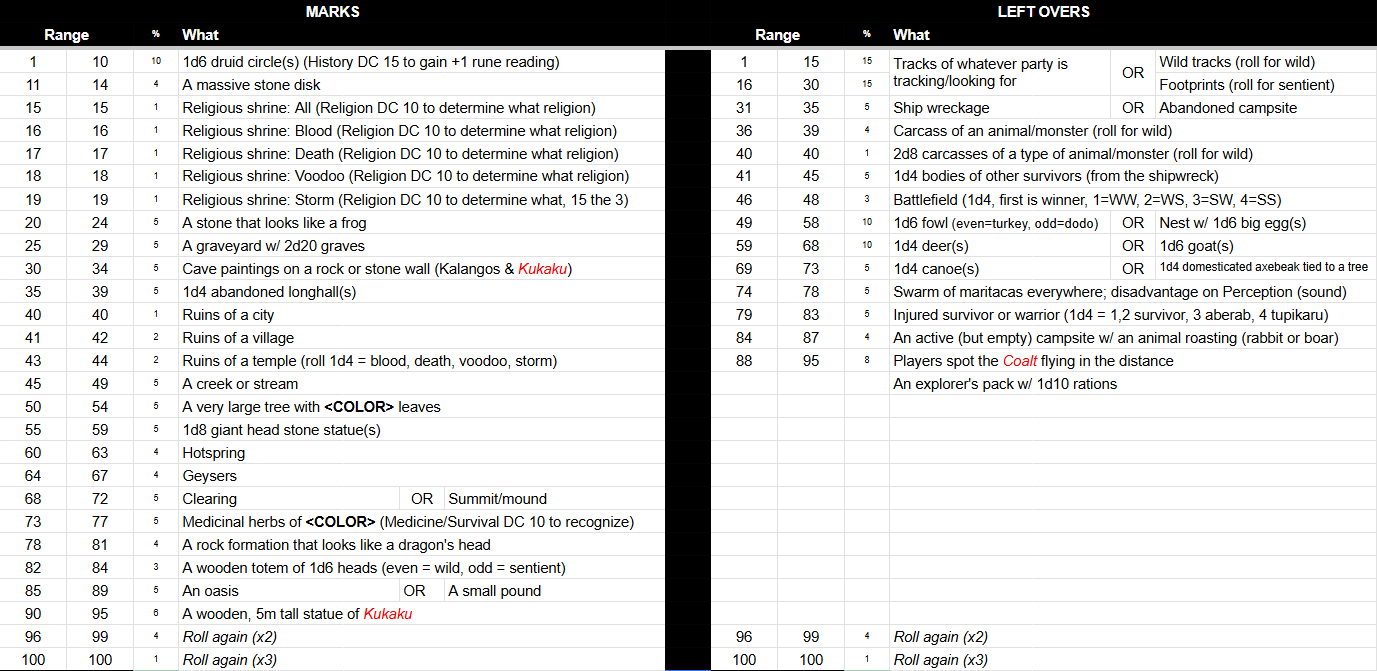
>>97495200
>please share
Pic related, but again, my tables not necessarily make sense for other settings/DM
But to offer a minimum amount of explanation:
>"MARKS" stand for "landmarks"; features of the land/environment
Its a pool of interesting features, but these don't typically add much (neither as a challenge, or as a reward). They are simply just there
As an example, let's take the entry 82-84 (3% chance - used to be 5% but I already rolled it once so it reduced). So when it appeared I rolled 1d6=3, meaning the totem had 3 figures/heads. Since odd=wild/even=sentient (pic related is mixed-up cause I dumb ESL), it means that I rolled once on my table for wild/beast encounters on that biome, then once for my sentient mob/humanoids table, then once again for the wild/beast. Ended up having a totem of a snap turtle + elf + giant crab
This is actually very interesting cause elves are not native to this continent and are the main player race - I actually rolled the ONLY elf mob, which is "elf pirates" on the beach (aka other explorers like the party, but ill-intentioned)
>"LEFT OVERS" stands for anything left behind
My encounter roll is 2d8, each number resulting on a type of encounter, and 12+ meaning no encounter. Additionally, hexes "already explored" have a bonus to that roll based on how many times it has been explored
8 = landmark
9 = wild encounter
10 = sentient encounter
11 = left overs
12+ = nothing
This means that the more a hex is travelled/known, the less likely it is to find a new landmark-type encounter, and more likely it is to get a left over -type encounter
>they can easily travel for a week in a minute of play
I'm using similar-sized hexes, and so far most sessions last for 2~3 days ingame, 3~4 hours real life. So I think what you need isn't slower travel mechanics, but rather more interesting things happening on each hex?
Please describe your process to go through 1 hex of travel so we can better understand the difference between our styles
>>
>>97497064
I lost all my tables when my laptop fried so I have lost all drive to make new tables. I had 100 entries per terrain type. very sad.
>>I'm using similar-sized hexes,
my game is about exploring a vast taiga, the lest wilderness in the north. So the PC's move around and roll to explore each hex if they want to try and find something. some times they find something that they want to explore later or return to, like recently when they found a mesolithic lighthouse and the next session they returned to it so they rode for 9 days to get there. they have bought a ship now to travel even faster, lol. Every day I roll 2d6, one for each half of the day, and on a 1 they get an encounter
>>

>>
File: tables.png (53.9 KB)
53.9 KB PNG
>>97497807
>I lost all my tables when my laptop fried
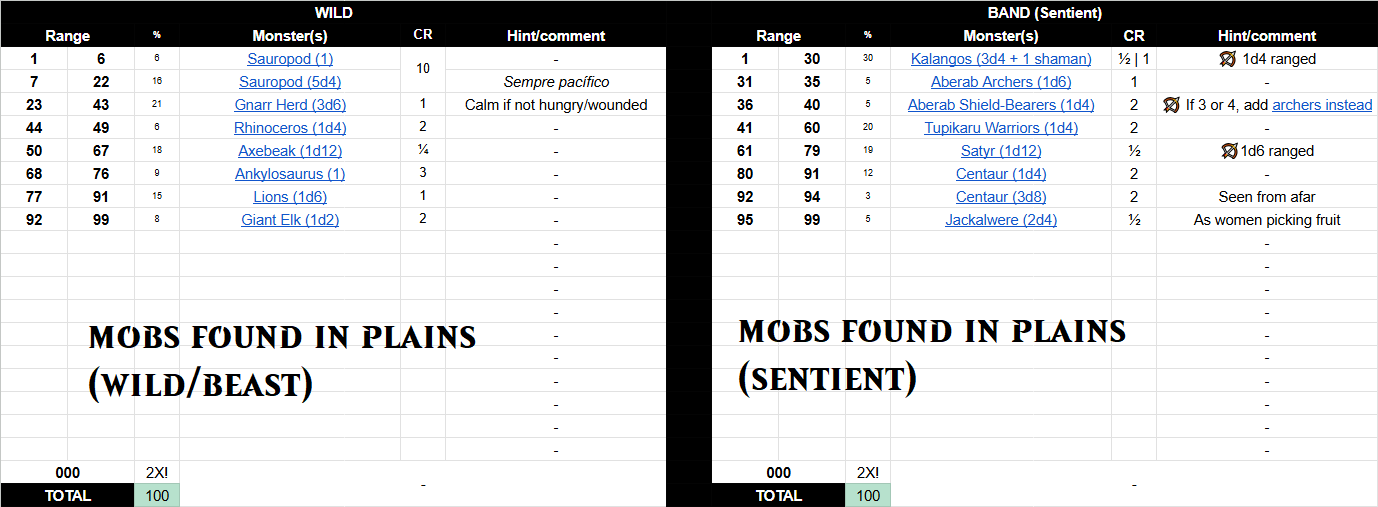
I'm sorry anon, this is indeed sad. Though desu, also a bit silly you didn't use something like Google Docs/Sheets for that... way more practical. I started using it because I can work on my stuff on either my desktop or my laptop (the one I actually use during sessions). Also, additional points due the fact I can hyper link stuff (my tables are on a Google Sheets, but statblocks are on a Google Doc... so I link it and can easily jump from one to the other)
>I had 100 entries per terrain type
At first I was overwhelmed by the idea of making a huge table, but the following steps helped me (in case they may help you recreate your material)
>started actually making sheet formulas so that I can simply input the % and it already calculated the d100 range
>this sound silly, but the trouble of updating the range for each entry over and over again would make it so much more troublesome
>this also allows me to use higher % than just 1 entry per %
>for wild, I went to the DND 5e DMG pg 302 to get some suggestions
>for sentient, i added 3 main setting mobs that are present on every biome (though at different %)
>filled the rest with biome-specific sentient races
It took me a couple of hours, but I got it done. I think one core aspect here is that I made it in a way that I could make initial tables faster (for early sessions) but could easily update them later. With the d100 formula, I can easily adjust the likelihood (%) of a given mob/encounter, or even add new entries. I think its easier to build only the necessary first, then add to it as you go
For non-mob encounters (like the landmarks/etc I shared), I tried to at least add 20 events to force some sort of creativity out of me
>>
File: WM Muito! (1) - Copy - Copy.jpg (103.1 KB)

103.1 KB JPG
>my game is about exploring a vast taiga
I see
I'm fairly new to hexcrawling, so I have no actual suggestions. Instead, I will just point out differences in style so we can go from there:
>Every day I roll 2d6, one for each half of the day
Its interesting you chose half a day, but I'm actually rolling for encounters EVERY hex. Let's break it down:
>2d6 a day means ~27.7% chance of at least 1 encounter
>meanwhile I'm rolling 2d8 (encounter if not 12+), which gives me ~76.5% chance of an encounter PER HEX
>my travel system allows a maximum of 4 hexes a day, though an average of 2 a day
>I also roll additionally for night encounters, though it might get chances reduced by good Survival check when setting camp
With that in mind, we can already see a big difference in style. On your system, players will roughly find 1 encounter each 4 days. On mine, a day gets ~3 rolls (2 during travel, 1 at night), which gives us a 98.7% chance something happens on an in-game day. Since your hexes are 6km and DnD assumes a average rate of ~36km/day... we have your party travelling 6 hexes a day... and finding something every 24 hexes. Of course, its a different style, but this seems a staggering low rate, with lots of travelling through empty nothingness
On my style, I wanted each hex to feel relevant - sure, some get rolled 12+ into nothing, those take ~5min RL to go through (even then, it still takes some time)
For the sake of completeness, just want to add that:
>My 2d8 roll gets a + modifier based on how many times that hex has been visited before. The ~76.5% chance is when first going into a hex
>The rate of a mob encounter is ~25% (the other ~51% are non-mobs)
>The chances drops to a minimum of 15.6% chance of finding something on a hex explored 6+ times (10.9% of that being wandering mobs)
Alsooo worth mentioning:
>Each instance of a biome has a different description
>I have a table of 6~8 different biome descriptions, often w/ gameplay relevance
>pic related
>>
File: travel_scene.jpg (141.6 KB)

141.6 KB JPG
>>97497807
Split my posts and forgot to tag you on >>97498177
Also, let me use this extra post space to just comment that in 3 sessions, my players (10 so far) only really been to 3 different places:
>1st session they traveled south around the coast of the Bay of the Sunken Obelisk (1)
>2nd session they traveled north through the savannah (2), and then into the yet-nameless jungle (3)
>3rd session they went back into the jungle, learned about the hill north but didn't get there
Note that despite no new place explored on 3rd session, it was a REALLY good session (see here for details >>97496962)
In terms of number of hexes travelled:
>The hex w/ X is the camp - they start from there so it doesn't count
>The single savannah hex northwest has been travelled x2
>In the jungle north, only 3 hexes have been travelled, one of them being travelled 4 times (if you look closer, there's a small red dotted line going towards the river - that hex has been travelled enough that it is considered a marked trail with easier travelling)
>On the beach south, they travelled through 4 hexes, each once
So in total:
>They travelled 12 hexes in 3 sessions (4 on average)
>Only 8 hexes have been visited (the 12 total travel is considering re-visited hexes)
Given my estimates on >>97498177, we can see how wildly different our approach is! While I calculated that on average they would find something in your campaign after ~24 hexes... took my players 3 sessions to travel half of that!!
>ps1: only 2 combats ever took place
>ps2: both were avoidable lol, one obviously so lol
>>
File: 1403686949397.jpg (17.8 KB)

17.8 KB JPG
>>97498066
Wild suggestion here, but you could read the thread or ignore it. Shit posting doesn't really add anything for anyone
>5e
Though I know this is bait, I'm actually finding 5e to be great for a West Marches campaign. This sounds really intuitive and I didn't think much of it before starting, but the fact DnD is so widespread makes it SO MUCH easier to add new players into the campaign. For instance, yesterday a had a new player that never played before, he arrived on time w/ his character sheet complete, and only took me 5 minutes to explain the hexcrawl homebrew mechanics to him before jumping into the game
Bitch all you want about DnD as a system (I myself am not a big fan of it), but a TTRPG that takes me 5 min to explain to a new player is VERY freakin' convenient for running a WM-style campaign where new players will be joining all the time
>tl;dr
u gay
>>
>>97498220
D&D is a good system
5e is trash
5e is especially trash for hexcrawling
Your game will fizzle out in a month or less due to """burnout""" i.e. it isn't fun
The only good D&D editions for this type of game are TSR editions
>>
File: 1404676130057.gif (79.2 KB)

79.2 KB GIF
>>97498241
>D&D is a good system
Eh, arguably
>5e is trash
Its polished trash. It streamlined a lot of things and made play easy, but it also went even deeper into DnD's main flaws. Overall, I prefer it over 3e
>5e is especially trash for hexcrawling
For hexcrawling yes, its not built for it so objectively you're right. However, factoring the West Marches component of having new players all the time, using a well known system is a MAJOR advantage
>Your game will fizzle out in a month or less due to """burnout"""
Let's see! I might burnout as DM cause I'm doing tons of prep, though I'm hoping most of the prep is only during this initial phase. The players, on the other hand, seem all excited enough to survive the 1 month threshold (for the 3-months threshold we still gotta see how things go). Note that we barely started (15 days ago) and I already had to turn down sessions (plural). So the demand is real, and being DnD its likely to keep up, because even if most current players burn out, there's a large pool of new players available
>The only good D&D editions for this type of game are TSR editions
Never played TSR editions so I take your word for it that they are good/better. But note that they being better for this doesn't make all other options unplayable
Also, again, are you factoring *teaching* those editions to new players? How long does it takes to teach it?
If it takes:
>more than 15 minutes to teach new players
>more than 4h research to learn how to DM it
Then it's already a pass
>>
>>97498177
>Its interesting you chose half a day, but I'm actually rolling for encounters EVERY hex.
I also rolled for every hex at first. but it took too much time. Timecrunch is a big problem, specially with how ADHD my players are. My logic is kind of reasoning that the party speed modulates the odds of encounter. that is to say, if they travel to the lighthouse and they cant keep a speed above 2 hexes they will have more encounters cus they are slow and easily caught. now that they got 4 in speed they are harder to pin.
what mapmaker do you use btw?
>>
File: environment challenges.png (40.5 KB)

40.5 KB PNG
>>97498525
>My logic is kind of reasoning that the party speed modulates the odds of encounter
Well, that makes sense... to an extend
More importantly, I think its important to talk about the definition of "encounter". Most people use it as "an event" (not necessarily combat). Meanwhile, I'm using it as "something worth describing"
Also worth mentioning that by rolling 2 dice instead of 1, I get a bell curve (your 2d6 is actually just 1d6 twice, mathematically). Bell curve means I can control a little bit better the likelihood of each entry (9 is the most common result):
>2 - major settlement
>3 - minor settlement
>4 - some mythical creature
>5 - a dungeon
>6 - treasure (table on pic related here >>97487487)
>7 - environment challenge (pic related)
>8 - landmark (>>97498115)
>9 - wild/wandering monsters
>10 - sentient creatures
>11 - left overs (>>97498115)
>12+ nothing
Reason I'm mentioning this is because, basically entries 5*, 6, 7, 8 and 11 are quickly resolved, since they are just either a small description, or at most a 10~15 minutes interaction (*dungeons are special), but adds to the environment/experience. Hexes are not just random hexes, its that hex where there's an island with a ruin in the middle, that beach we found the weird totem, that clearing we found a native camp, etc. Its a 43.75% chance of finding something small, yet worth of noting. This, together with a terrain description table, brings out life to the world. My players only explored 8 hexes, but out of those only 6 had nothing worth noting about
ALSO worth mentioning again the fact that the chance these come up is greatly reduced as they get familiar with hexes, avoiding losing too much time on old stuff.
>tl;dr
your world might be lacking simpler things to be found, like a mossy waystone or and abandoned camp
>what mapmaker do you use btw?
Main map is on paper & colored pen, but I'm also making a copy on Inknate (free version); see >>97496962
>>
>>97498525
>>97498595
To sum it up - I'm not disagreeing with the premise that "the faster you travel the less likely you're to run into trouble" - it makes sense. My point is that travelling fast shouldn't reduce the likelihood of the PARTY finding things, such as landmarks or environment features
>>
>>97498595
>More importantly, I think its important to talk about the definition of "encounter". Most people use it as "an event" (not necessarily combat). Meanwhile, I'm using it as "something worth describing"
Ah, I see. in my game players have to roll a exploration check to find things worth describing. unless they are extremely obvious, like the aforementioned lighthouse
>>
>>97498620
>players have to roll a exploration check
Care to explain why?
That sounds like a bit of a bad plan - players won't find things interesting unless they investigate them, which they won't be interested in doing 99% of the time because they haven't noticed anything interesting there
To make a parallel, those rolls I described are things they *run into*, without any effort. Many times, those things have associated skill checks to delve deeper (history check to read the runes, religion to understand the pantheon, investigation to whatever, etc). But the initial discovery, to spring up their initial interest, is "free". They just find it
Thinking about real life - how many times, random things caught your attention?
- Usually, things get our attention
- *Then* we curiously look deeper into it
>players have to roll a exploration check
One major/very common pitfall from D20 or similar systems is the DM relying too much on checks/dice roll to progress the story. Don't be a slave to it!
>>
>>
>>
>>97498763
>how many post have you made about doing just that, in just this thread?
Idk. Wanna count?
My point is that, given that D&D 5e is not built to work for either West Marches or hexcrawl styles of play, I have to homebrew a lot of content to fit the game into those styles. Because if that, I'm avoiding any unnecessary homebrewing of things that are *not* related to WM/hexcrawl
So really, please point out homebrew things I've mentioned on this thread that are not due to one or both of these styles
>>97498778
>6 kilometers of wilderness is not easily explored
That's not really an argument, anon
What is "to explore"?
Is to find everything there is to find?
How do you handle that?
Is it a single, binary skill check, find it all or find nothing?
Are there more than 1 thing on each hex to be found?
My point is that players should naturally encounter things without having to active look for them. Now, sure, some things will be hidden from plain sight, and even among the things found "check-free", it might require additional check for PCs to find more about it and actually get anything out of it (one thing is finding a chest, another thing is opening it)
If you don't believe me, give it a try. Walk 6 kilometers in any direction, from any starting point, and think about things you found that could have an interesting story behind (if investigated)
This doesn't mean they *can't* actively look for things, and sure, doing so will increase the likelihood of finding things. But still, a lot of things you just... find. It's also relevant to point out that in terms of gameplay, you're double taxing your players -they already spent resource/time going there, to always ask for a check on top of that is a double-tax
I mean... my prediction is that, based on your description, they on average travel 24 hexes before something relevant happens. Is that true? How is the actual rate? Right now my campaign got 75% of the hexes having something of note
>>
>>97498763
>>97498950
I know you're bait, but just because, I checked the document I provide to players about the group/campaign, there are only 2 house rules that are not related to WM/hexcrawl:
>pc don't gain stat bonus based on their race
>I (the DM) roll death saving throws hidden
Those two are my personal preference as DM, everything else is WM/hexcrawl related